When to charge and discharge a battery, from your load forecast
A battery cuts demand charges only if it is full when the real peak arrives. The best schedule charges in low-load, low-price hours and discharges into the hours your forecast says will set the peak. 4castPlannr forecasts hourly load from your meter data and plans the schedule within the battery's size, power and efficiency.
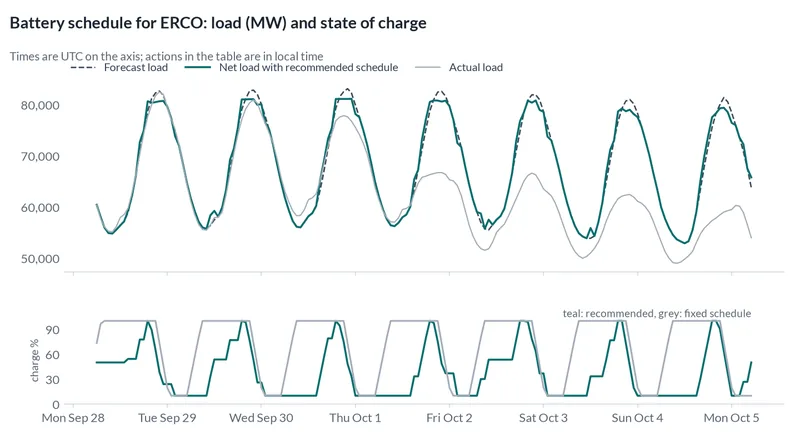
The decision you make every week
A fixed timer (charge overnight, discharge every evening) is simple, but peaks move with weather and operations. Discharge on the wrong day and the battery is empty when the monthly peak hits.
Ask it in your own words
- Forecast our site's hourly load for next week and tell me when to run the battery.
- How do I schedule a 2 MWh battery to cut our monthly demand charge?
- Compare our fixed charge schedule with a forecast-based one.
What to send
- Hourly or 15-minute load data from your utility portal or meter, as CSV.
- Battery size, power rating and efficiency, and your tariff (energy and demand charges).
- Your current schedule, if any.
What you get back
- An hourly load forecast with a range.
- A charge and discharge schedule for the coming days.
- Expected peak and cost for the schedule and for your current rule.
Tried on public data
Each example below ran end to end on a public dataset. Real numbers, including results that were not in our favor.
| Case study | Data | Typical error | Better than repeating last season | Plan result on held-back data |
|---|---|---|---|---|
| Grid demand and battery schedule | United States | 5.7% | 21% | Planned, see case study |
Plan costs in the case studies are example values. Typical error is the share of actual volume the forecast missed by, measured on past data the model had not seen.
What we do with your data
Load is forecast with the method that tested best on your history. The schedule is an optimization model of the battery (capacity, power limits, round-trip efficiency, wear) that minimizes energy cost plus the demand charge set by the highest hour.
Case studies
-
Grid demand and battery schedule
U.S. EIA grid data: a 7-day hourly demand forecast for 5 balancing authorities, compared with the operators' own forecast, plus a battery schedule for Texas.
United States · 5.7% error · 21% better than repeating last season
Questions
Do you control the battery directly?
No. We send the schedule; your battery system or operator applies it. Direct control integrations are not available.
How accurate is the load forecast?
It depends on your site. On public grid data our 7-day forecasts were off by about the amount shown above, while the grid operators' own day-ahead forecast did better. We always report both kinds of comparison when you have an existing forecast.
Are the savings in your example real money?
No. The battery size, prices and schedule rule in our example are example values chosen to show the method, not a real tariff. Your savings depend on your tariff and battery.
Try it on your own data
Upload your export and describe the decision. Your first forecast is free for the first 50 businesses.
Related use cases
- Staffing plans for call centers and service businesses
Forecast calls, visits or jobs per day and get a shift plan that covers them at the lowest cost.
- Production planning for food and beverage producers
Plan what to make each day on a shared line, with shelf life, changeovers and capacity built in.